

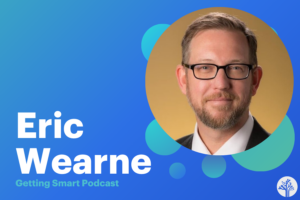
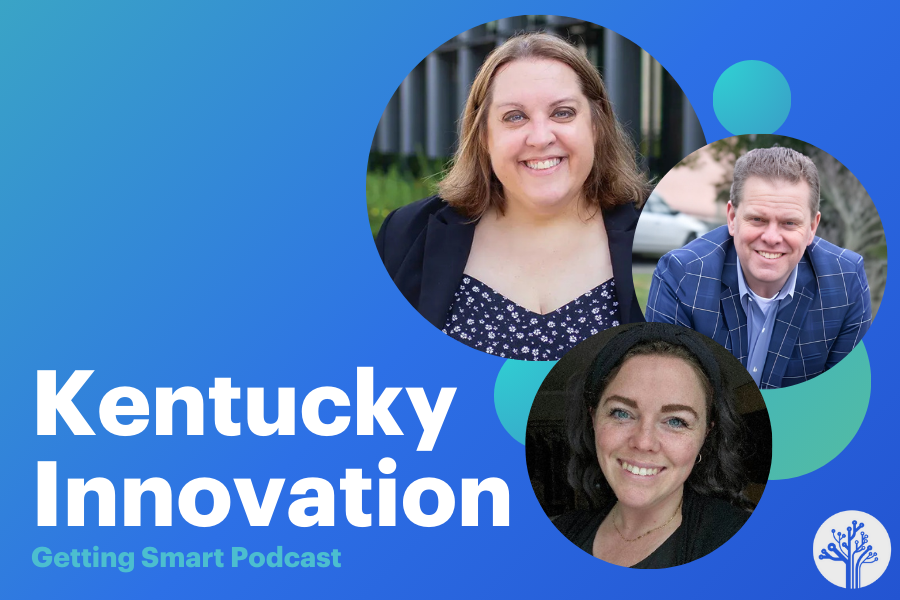
David Cook, Sarah Snipes and Karen Perry on Building Sustainable Education Systems
Key Points
-
Kentucky’s “United We Learn” initiative emphasizes community engagement, empowering districts to co-create educational solutions that address local needs.
-
The initiative champions competency-based learning and local accountability systems, creating sustainable, student-centered models for education transformation.
Shownotes





The latest episode of the Getting Smart Podcast dives into Kentucky’s innovative “United We Learn” initiative, which emphasizes community-driven education, competency-based learning, and local accountability systems. Host Rebecca Midles is joined by Sarah Snipes, Director of Innovative Learning at the Kentucky Department of Education; Karen Perry, Executive Director at the Center for Next Generation Leadership; and David Cook, former Director of Innovative Learning, to discuss how Kentucky is building sustainable systems of education transformation. Together, they explore the importance of trust, collaboration, and shared vision in creating vibrant learning experiences for every student. Tune in to hear how Kentucky’s efforts are inspiring education leaders nationwide, and learn why this model could be a blueprint for other states.
Outline
- (00:00) Introduction & Guest Roles
- (06:30) Building Networks & Partnerships
- (16:03) Creating Shared Vision
- (26:34) Portrait of a Learner Process
- (32:47) District Models & Implementation
- (36:00) Sustainability & Looking Ahead
Introduction & Guest Roles
Rebecca Midles: If you’re listening to the Getting Smart Podcast, I’m Rebecca Midles. Much of the conversation in education is about fixing what’s broken, and at Getting Smart, we are interested in approaches that start from assets—what’s already working in the community, what capacity already exists, and how do we build systems, not just pockets of excellence, that help those assets spread and become sustainable.
Kentucky has done this in a really intentional way—building intermediary partnerships and peer networks that connect districts and leverage existing infrastructure. I want to talk with three practitioners positioned differently in that system about how it actually works in practice. Today, I’m joined by Sarah Snipes, current Director of Innovative Learning at the Kentucky Department of Education; Karen Perry, Executive Director at the Center for Next Generation Leadership; and David Cook, former Director of Innovative Learning at the Kentucky Department of Education. Welcome. Before we dive in, for our listeners unfamiliar with Kentucky’s approach, can you briefly describe your current roles in the work and what “United We Learn” looks like on the ground today?
Sarah Snipes: I’ll start, Rebecca, and just say, as the current director of the Division of Innovation at the Kentucky Department of Education, my role is primarily to support the leadership of a small but mighty team, as we say at the department, that’s really charged with championing this unified vision around “United We Learn.” We focus on creating resources, building field capacity, and strengthening the department’s own capacity to understand what that vision looks like as it transforms the student experience day to day.
I am joined by a wonderful team—program managers, several consultants, and some field-based regional innovation specialists whose job is to go out and walk side by side with our districts and their community partners to make the changes needed to create more vibrant learning experiences for every student, innovate with assessment and accountability, and build and strengthen community partnerships in that process.
Rebecca Midles: Wonderful. Thank you.
David Cook: So, I’m David Cook. It’s really fun to say what I’m going to say, Rebecca—I’m the guy who used to be Sarah Snipes. I love that. Sometimes, when you’re talking about your previous job, you say, “Well, I was,” but Sarah Snipes is the Director of Innovation, and I just used to be the Director of Innovation.
But I think I bring to this conversation the history, the way we started this work, and what I think is most powerful about this work related to what I’ve done. I was at the department for almost three decades. We tried this in different ways at different times, and it didn’t work. There are things about this process that made it work, and we’re talking about those today. And our friend Karen is here, which is one of the big reasons why it worked.
I’m now in that mental state where 49 other states in this country—a lot of them are right at the edge of wanting to do something like this—and they’ve been waiting for something. I think what we’re talking about today is what they’ve been waiting to hear: a state telling us how far we’ve come in the process, and that it can be done. You can get to this point in the process. That’s what I’m excited about—listening, particularly to Sarah and Karen.
Karen Perry: My name is Karen Perry. I am the Executive Director of the Center for Next Generation Leadership here at the University of Kentucky. Our center is about 15 years old, and we’ve been working to advance the upgrade of school and the learning experience for learners across Kentucky, primarily through building the capacity of leaders to lead for change and upgrade systems of learning.
We advocate for things like competency-based and student-centered learning, performance assessment, and vibrant learning for every student in Kentucky. We’ve been at that work with a small but mighty and amazing team of leaders across Kentucky for 15 years now, and we’re excited to be part of the latest effort at upgrading education in Kentucky. Kentucky has a long history of innovation in education and taking big swings, so it is a joy for us to be part of that. From our position at the university, we are connected to the College of Education, so we all have deep expertise in P-12 schools and higher education, as well as some research capacity. But primarily, we’re a leadership shop. I would join David and Sarah in their enthusiasm for what’s happening right now across Kentucky.
There is a real sense that there is a window of opportunity and optimism that feels very real across the Commonwealth about the potential of what could happen here in our next chapter of innovation in education. I’m really excited to be part of it from our perspective and as an intermediary in the state.
Rebecca Midles: Fans, big fan. I would love to say that you guys have always been great about sharing out loud the journey. I feel like whenever I’m at a gathering, I’m always in your sessions, and I’m always sharing about what you guys put out there and the resources you’ve really created. I think it’s quite a movement, and I know you have a strong network with other state leaders.
I appreciate, Sarah, you opening by talking about the team; David, you talking about the legacy work of the different shifts of the intermediary and always being a very good advocate for that across the system; and Karen, bringing in that university piece. Acknowledging how exciting this is for me as well, I’ve written about how I think this is super important for states to be thinking about. And in this mix, what’s happening across regional organizations—maybe not necessarily what people would call intermediaries, but sometimes ESDs or ISDs—and how they could be seen, how this would fit with them as well.
So let’s get to it because I think there’s lots for people to hear about. A big part of that strategy that you have started to hit on is that you are focused on connecting districts through local laboratories of learning, so to speak—not just occasional meetings, but active working coalitions.
Building Networks & Partnerships
Rebecca Midles: Why are these networks so powerful in this kind of systems change?
Sarah Snipes: Traditionally, I think what folks are used to—not only in our state but many others—has been a one-way flow of information from a Department of Education, receiving those checkboxes in which to be compliant. That’s very transactional in the sense that departments of education typically provide guidance and resources around those compliance measures, whether they be federal or state requirements.
What we’ve really done is shift that tremendously—and in the best of ways—by focusing on reciprocity. Here in Kentucky, we’ve emphasized the Department of Education and our partners, like UK NextGen, coming in to really understand your context, helping connect you with others across the state who may have similar demographics, challenges, or successes. We’ve been what I call a “red thread.” Instead of coming to our districts as a compliance measure within our system, it’s been more of an authentic partnership.
As our conversations and leadership at the state level have changed to be more about partnership than competition, we’ve focused on tackling problems head-on together, collectively. We recognize that no one in our districts is facing any one given challenge alone. All of our innovators and movers and shakers have experienced different paths, but they’ve all had very similar experiences somewhere along the way.
Our networks have formed rather organically in some ways, but I think it all launched from a very structured place. Coming from CCSSO’s history—and I’m sure David could speak to this with the Innovation Lab Network—David really led the transition of that to the state level, having our innovative learning network. That has transformed over time and evolved with the needs of the field into these individual connections between districts. Our regional team, UK NextGen, and others rally around a district, really seek to understand them on a personalized level, and cater supports—not by coming in with the answers, but by facilitating meaningful conversations and collaborations across those different districts. It could be our furthest west and our furthest east districts, who may never cross paths in conversation around some of these issues.
Rebecca Midles: Excellent. So thinking about who’s in the room in those examples, or what problems we’re trying to solve together, what happens differently when districts learn from other districts, especially ones facing similar constraints, rather than being handed, say, a model from the state?
David Cook: I think the added piece, which Sarah didn’t get to, is not really about networks but about the local coalitions that were created in each one of these communities. To me, in the early stages especially, that was one of the reasons why this was different. Not only were people talking together in common groups, Rebecca, but they were also listening in a different way to their communities.
The interesting thing was, I think, in most of those communities, they were hearing the same kinds of things. It led to another thread that has run through this process: this different way of engaging communities in a conversation. You’ve created a much deeper, more systemic—not just systematic—but systemic, sustainable change. When they come to those rooms together and talk about very similar ideas, the greatest part of it is that we didn’t tell them. Sarah, I think back to when we made that decision with the state board to go with more of a competency framework for a portrait, as opposed to saying, “There’s your portrait. Do it. Be it.”
All of the things we’ve done in the last five years have been in an effort to allow every community to have some ownership—leading up to the accountability changes and everything else. But it’s all been in service to the individual community as the center.
Karen Perry: The people who are closest to the innovation can really fuel the progress, share best practices, and share good ideas across lots of folks, including regional cooperatives, districts themselves, and community partners.
If you think about a network, networks can be built in different ways. One version, and I would say sort of an old-school version of a network, is like a hub of a wheel—someone in the center projecting out what everyone should be doing. That is not the way we have built this learning network. It’s really more like everybody’s in this ecosystem, and there are lots of nodes in the ecosystem learning from one another.
What happens differently when you do that is the people who are closest to the change that needs to happen will surface the ideas. The ideas will bubble up from that place, rather than someone from on high saying, “This is the thing everyone should do.” It’s really organic. Sometimes it’s not the cleanest, and sometimes it takes a little extra time, but it is, I think, really authentic when that kind of change can happen and that growth can spread in a way that is closest to the people who are affected—students, educators, the communities, the parents, and those people they serve. That’s what’s really exciting about this moment in Kentucky right now.
Rebecca Midles: I love the connections you’re making about competency-based learning in action. It’s certainly true for adults. We know this to be true—that we are going to show up as professionals more engaged when we’re treated as professionals, right? Having that ability to see what’s expected, to see where we fall, to see what our strengths are, what needs to be worked on, and then to share in a network is truly collaborative. Like you said, they’re creating something that’s very motivating and sustainable, and people have a lot of ownership in that.
Creating Shared Vision
Rebecca Midles: So let’s dive into that just a little bit more. If I’m listening and I’m from a state, what infrastructure or support do you intentionally need to function well? Lessons learned would be helpful, or moving forward, but what are you setting up to make sure that happens outside of that competency-based progression where people can see where they fit?
David Cook: I’ll just do the history lesson, and then you can jump on. When you said that, Rebecca, the first thing that came into my mind was what I think is the second important thing about the way this process was different. The first is the community connection and engagement. The second is when our leader at the time decided we’re going to have a new vision for education in Kentucky. Jason Glass said to the community, “This isn’t the Department of Education’s vision.”
From the very beginning of this particular process, it started with Jason saying, “No, I want to know what the community thinks our vision should be.” You go all the way back to the town halls and all the data that was collected on the writing of the report—the United We Learn report—and the big ideas and everything that came out of that. That has continued on through everything, through the ACCDSA grant, and through all of the other stuff.
It started with a very different way of thinking about vision. Instead of a Department of Education or a State Board of Education saying, “This is your vision, and you will live this,” it was, “What do you think?” By asking some very simple questions about what people want the education system to look like, you built a vision that was entirely created by everybody—not just a small group of people sitting at the Department of Education.
It became embedded. I really think about the appointment of the current commissioner as a result of that because I think the state board was asking different questions of candidates when they hired Dr. Fletcher. I think they were saying, instead of, “What’s your vision for education in Kentucky?” they were looking at those candidates and saying, “Here’s our vision, and it was designed by the people of Kentucky. How are you going to lead that vision?” That’s an entirely different conversation.
This element of this work is so important for people to understand. A part of what you have to have for this to work is an engaged set of statewide stakeholders assisting you in the process. You can’t just make it be, “Here it is. Go with it.” You have to have something that they go, “Well, yeah, we were a part of that. We know how that was designed.”
Rebecca Midles: I am hearing that intentionally casting that from the very beginning is key. And what I would say is recognizing that when we say “shared vision” and toss it out so often, truly taking the time to build a shared vision so that people are showing up to those discussions ready—not just hearing it for the first time and circling back. So what I hear you saying, David—and Karen, you can pick it up from there—is, yes, intentionally setting it up to be that shared vision. Then, what are the structures to help sustain it? You can even add to that each of the organizations you represent and what you uniquely do to support that.
Sarah Snipes: Rebecca, I would just say that once you had that vision, which is a huge piece of the puzzle, what became frustrating and surprising to me all at the same time is that, regardless of a state department’s best communication efforts, there are still people—surprising, I know—educators who are not flocking to our state websites every single day or monitoring those communication lines. They’re in front of their kids, right? They’re doing the work in the trenches.
Regardless of all this great work and intention that had been put into the vision itself and the crafting of that, we still had to go find our champions. Who do people hear from? Who do people trust in the field every day for support? That’s a big reason why Karen is with us in this work. When we looked at who was already making moves, building rapport and trust in the field, and who the department could turn to in order to help establish a trusting new type of role between districts, we could look to UK NextGen. They could help us take the hand of those communities and say, “We’re in this together. This looks very different. This might feel very weird in the moment.”
Because they had that trusting relationship and partnership first with so many of our districts—and if not our districts, then our regional educational cooperatives—it made that relationship establishment so much easier for us from the state side. They helped us get the message out. They could advocate and explain the vision where maybe we didn’t yet have the door open to some of those conversations. I think just showing up in spaces together was key. We had convenings where anyone who played a role in that at all was just physically in the room together. I think the signaling of that was just as important as the vision itself.
Rebecca Midles: Love that.
Karen Perry: Yeah, I’d agree with both David and Sarah. It’s really important to note that this all is by Kentuckians, for Kentuckians. If that’s the case, then every Kentuckian has a place in this somewhere. So, “What is your place in this whole effort?” is a really good and important question to ask for everybody who’s here. From the perspective of an intermediary, I think our center is really… It’s a pretty small team, but we have very experienced leaders who have led this work. I think that credibility is really important, as is the longevity of the conversation we have been working toward here for a decade and a half at the center.
Karen Perry: From the perspective of an intermediary, I think our center is really… It’s a pretty small team, but we have very experienced leaders who have led this work. I think that credibility is really important, as is the longevity of the conversation we have been working toward here for a decade and a half at the center. This includes lots of different iterations of the work, but we’ve been consistent in our anchor: we have to upgrade the learning experience. Competency-based and student-centered learning, performance assessment, and all of those elements are key. The accountability system should honor, incentivize, and recognize that, which is the Kentucky United We Learn vision—the most recent chapter of that.
We’re capacity builders. We’re not the state education agency, which is in the regulatory business. We are people who have done this in various ways and places. We get alongside districts, but we’re not the boss of anybody here. What we do have is lived experience, passion, and hard-earned wisdom, as well as connections with other places. We can amplify the signals we see from the rest of the field and let people know. I remember very clearly a district saying to me early on when I first got here, “You pay attention to what is next. I’m trying to run a district. I’m busy. I want to know what’s next, and I will trust you to help us find our way into that conversation about what is next.”
The “what is next” should be co-created, but still, people are looking toward others with expertise. In that way, it’s really an honor and a joy to focus on this conversation with districts as we go and to learn alongside the Department of Education, regional co-ops, community partners, and all of those people.
Rebecca Midles: That’s commendable. I’m just going to point out that we’re going to put some links in our show notes about how you have amplified that work. We’ll continue to do so, directing people to different sites where they can see more of that.
David Cook: One of the other things that I think has been really fascinating is to watch both the way partnerships have grown and changed and how partners have been guided and subtracted. It’s important to be that flexible and organic in the way we’ve done things. We’ve also gone through the highs and lows of things working and not working, going maybe too far in certain areas and pulling back, or not going far enough and having to go farther.
I think, again, back to the point that it was begun the right way, it allowed for a lot of change to occur over the course of the process. We talked early on about the radical inclusion of this process. It had never been anything we’d ever done before, where we literally fought to make sure every voice was heard. It wasn’t just, “Hey, we’re going to do a nice thing and pull in this person that we know and that person that we know.” It was, “We’re going to think differently about what inclusion means.” The design elements that we’ve lived with throughout the whole time of this process—that’s one of them. We’ve really been about including everybody so that the original vision doesn’t go away.
Rebecca Midles: Mm-hmm. And the importance of circling back to that. I know we’ve talked—you’ve shared before in the past—about being intentional along what David said and Karen said about how the Department of Education shows up in this work. Can you speak a little bit more about that?
Sarah Snipes: Absolutely. As a learning partner, rather than holding people accountable for ensuring that our compliance measures are happening in our schools and districts each day, it’s really been an incredible experience to walk alongside districts. We’ve worked within what at first was 18 districts, and that has rapidly increased as folks have organically joined in on the efforts.
To take a cohort of 18 districts who were early runners in this work—who wanted to go out and explore—we didn’t have an answer to the challenges. Actually, we co-created the challenge, right? Kentuckians came together, painted this picture of the current and future state of education in Kentucky, and then we didn’t come in with an answer or solution to that. It was more about listening. I mean, listening is kind of a thread throughout this entire conversation.
We went to our districts and said, “You all are the ones who can figure this out.” To trust them to do so and then to promise them that thread back into the state to synthesize that learning, lift it up, and provide relevant, meaningful responses based on those lessons learned directly from the districts themselves—that’s transformed our relationship as a Department of Education.
Now we have this reciprocal partnership where districts can better trust us to listen and respond to their very real needs, rather than making assumptions about what we think they need. We know every county’s district is different, every district is different, and their communities are different. This really honors learning and listening. Everything from our portrait of a learner to our new accountability system bill that is being processed right now through legislation has been grounded in what our districts have done, what they have learned, and what they say is important to transform education.
Rebecca Midles: When you set that up, you’ve got people showing up in a different way because they know they’re going to be involved. They know it’s not going to be a sit-and-get; they’re not going to be passive—they’re going to be active. That becomes a culture. Can you walk us through what that looks like for a district, maybe step by step, about building a portrait? What’s an example of that?
District Models & Implementation
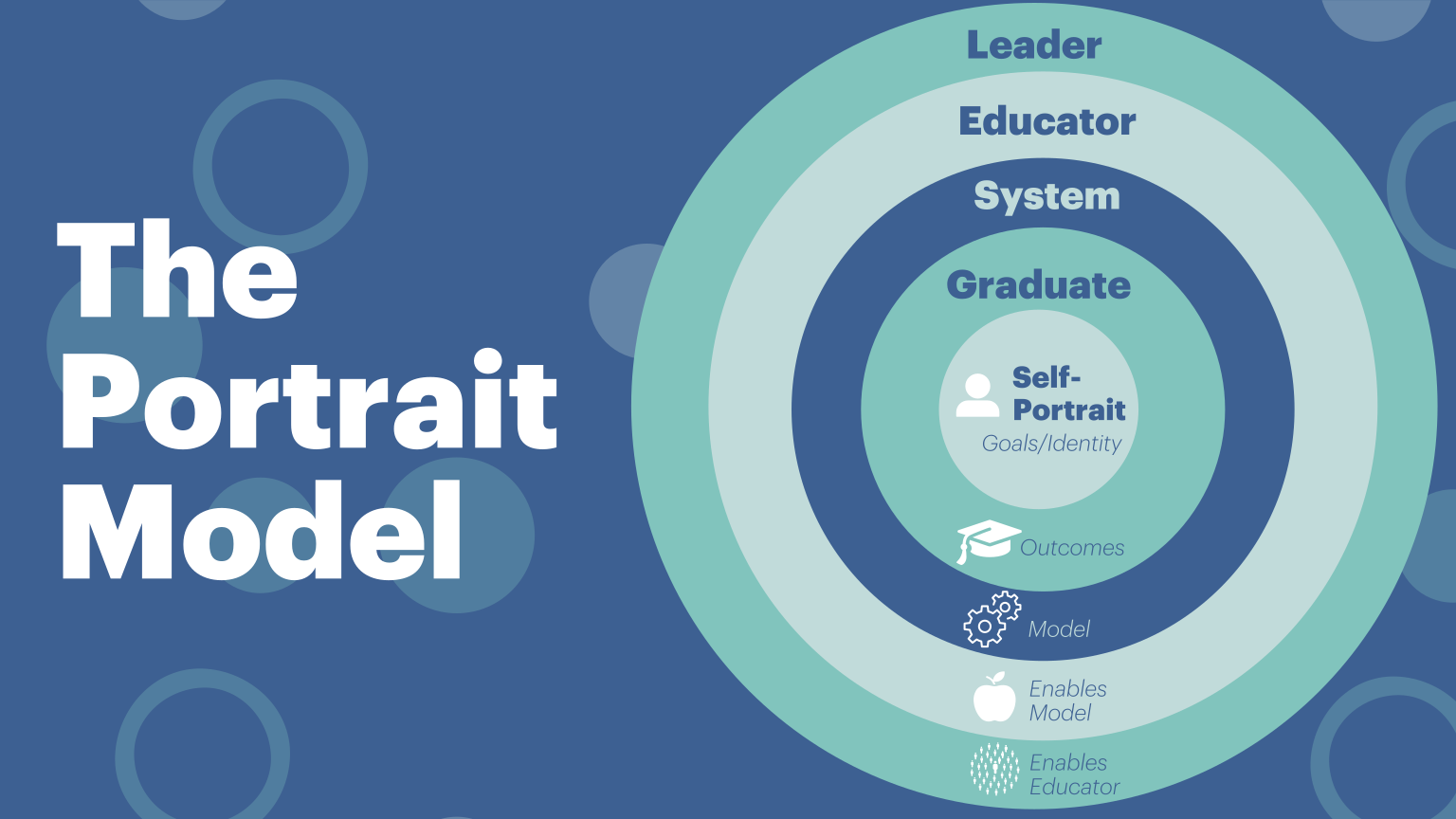
Karen Perry: We did a lot of this work across the Commonwealth as NextGen and did a lot of good learning along the way. Stripped down to its very essence, the portrait of a graduate conversation starts with a really simple question:
What do you want students to know, be able to do, and be like by the time they leave us?
If that’s really the driving question, and your community shows up and answers that—which we have done, not just as NextGen but across the Commonwealth—I think we now have 155 or 160 local portraits of a learner out of 171 districts. When you see that conversation out in communities and people show up and answer the question, we have observed that people largely land in very similar places: communication, collaboration, creativity, critical thinking, and innovation. Those kinds of things are what bubble up.
But the conversation is important because it’s trust-building, as Sarah said. Your community says, “Here are the outcomes that we want.” It’s then up to the school district to co-create with communities learning experiences that students have so they can get good at that set of competencies. Then we go back and design vibrant learning experiences for kids, and we have to assess that in a different way, which is where performance assessment fits in.
We have tons of districts now doing defenses of learning with students, performance tasks, internships, and authentic learning experiences that demonstrate, for example, that a student is a good collaborator and a critical thinker. There aren’t necessarily great standardized tests for those kinds of competencies, so performance assessment enters the equation.
Now, our community has spoken and said, “Here are the outcomes that we wanted.” We’ve designed learning so kids can get stronger at those skills and competencies. We are assessing the degree to which they’re getting good at that. Then, we have to report that back out to the community and say, “Here’s where we are on that.” That is the local accountability part of this that’s really essential.
That’s how all of these ideas are coming together and are related to one another. Taking that last turn around to a community to say, “We heard what you said. We designed learning. We’ve assessed the degree to which students are achieving those goals. Now we’re reporting that back out to you. How do we move forward together to get better at this so we can better support kids and be more responsive to the needs of our community moving forward?”
The Kentucky United We Learn vision starts with the idea of “for a more prosperous Kentucky.” Our commitment here is that this needs to not only make better learning for kids but also result in a more prosperous Kentucky with more economic opportunities, better-prepared students, citizens, employees, and leaders. That’s how those things are related. It’s been really fascinating to see it spread independently in some ways across all of these communities but largely landing in very similar ways. Then you bring the network together so people can learn from one another about how to operationalize those big ideas. It’s been really heartening and exciting to watch it spread organically across the Commonwealth.
David Cook: A huge word, Rebecca, that I think has followed this work in this iteration and all the things Karen just described is trust. I think local communities have begun to trust their district leadership and vice versa. Our district leadership now has a different look at their community members. And then all of those communities are trusting the department and trusting the state that they’re actually going to do this.
I’m going to use the name of one of our favorite superintendents, especially Karen’s, and that’s Travis Hamby. I can’t explain how many times in the last 30 years Travis Hamby would call me—not 30, because Travis hasn’t been a superintendent that long—but he would say, “You’re going to drop this on us. You’re not going to follow through on this. You’re not going to get to the finish line on this.”
Travis really didn’t ever say that to me once we got into the local labs, the coalitions, and the council because he saw us believing ourselves that it was going to happen. The trust we have built over the course of this to get it to this point is hugely important. When people are thinking about doing this, you can’t just say, “We’re going to do it,” and then not do it. You have to follow through.
The steps Karen just described—going from, “Here’s our portrait,” developing and designing that, “Here’s how we’re going to assess it,” and “Here’s what it’s going to look like when we measure it”—all of that being real and not just something that a district has to do on its own is hugely important to the sustainability of all this. I just wanted to make sure we didn’t forget that as we think about listening to some really great examples of models that have come out of these local accountability systems.
Rebecca Midles: I’m going to want you to share a little more about the models, but what I also hear Karen and David really bringing home is that trust is built through that transparent action. It’s one thing to bring people together and be part of it, but there’s also got to be follow-through and transparency in that structure to build trust. Sarah, what are some other models you might want to highlight about this work?
Sustainability & Looking Ahead
Sarah Snipes: We are in a great place. As Karen mentioned, 155 to 160 of our districts are either developing or have developed a portrait of a learner. Based on all of our learnings, beginning with defining success for students is really the launching point for districts as they explore and build toward local accountability systems.
For example, Greenup County in northeastern Kentucky has developed Grade 8 as their set of competencies. Greenup County, as well as others like Fleming, Allen, and Shelby, and so many others—155 districts in total—are well on their way. They have robust student portfolio systems that empower students with agency to tell the story of their own learning over time.
We’re starting to see what many leaders have told us is meaningful sustainability over time, regardless of leadership transitions. This has gone back to both community accountability—“Hey, we designed this together; what happens to it next?”—and embedding these practices into policy. For example, many districts are now shifting to a place where internships and successful defenses of learning in front of a panel of community members are graduation requirements for their students. It just becomes the new norm in those places.
We’ve heard stories where systems that require those experiences in fifth, eighth, and 12th grades have students who don’t know any different. They don’t know that school could happen any other way than boldly telling the story of their learning and their journey over time as a learner. That’s exciting to us.
In the spread of those models, going back to the networking, it’s one thing for us to lift up and share stories—and that is so important. It’s another to let people see it, to see that messy middle of the design. I don’t think any district leader in our state would tell you they have it all figured out, but they welcome people in. On a Tuesday, we can take folks to sit in on defense panels, walk through classrooms, and talk to students. People are just so open to that.
We also try to make sure that they get something out of that in return. So, they open their doors, and we help them build and grow that system. We don’t just take from them; we also give back so that they learn something in the process. All of those models look similar but also have that contextual flavor of what the local community really wants.
Our districts have learned so much together. You can definitely see the footprints and fingerprints of those learnings across districts. I think that’s just beautiful for the tapestry of this whole effort. Everyone looks different in what that means to their community, but it’s so great to go in and talk to one district—Woodford County, for example. Each and every time, they will share in their story from the beginning which districts really brought them to the point where they are. It’s a growing list—I think eight to 10 districts so far—that they’ve gone and visited, talked to, and consulted with. That’s unique and really powerful.
Rebecca Midles: That feels like such a true coalition—a cohort of people coming together and really honoring that work. So many great intentional design principles you’re sharing around this. I’m thinking about people listening and getting excited, like I do when I listen to you all. If I’m at a state level and I’m thinking about this, a lot of challenges with education innovation are that it often fades when some of the incentives or grant funding ends, or when leadership changes. You’ve been building something meant to be ready for that. I mean, you yourselves have experienced that. What are you doing to set that up? What can people hear that could be applicable? What’s an intentional approach that you’ve done to build capacity to sustain this?
David Cook: I mentioned it a little bit earlier, Rebecca. I think the depth to which we embedded the vision in everybody has led to a place where sustainability is much more possible because people are coming for the vision. They’re not coming because of a person or because of a particular administration.
As people leave the department, as people leave, as we switch commissioners, as we do all these things, the vision is so deeply embedded in so many people across the state now that a lot of it is going to continue and sustain itself. Obviously, it’s going to evolve and change, but it’s a different conversation than I’ve seen in the past, where we tried to do something and said, “Man, it worked,” but then five years later, it wasn’t working anymore.
This feels like something that, because we invited everybody to the table from the beginning, has a different sense of where we’re going. Sarah and Karen, I’d love to hear how you feel about that. I think sustainability in this particular instance has to do with what and why we’re doing it, not who did it. It’s not about who did this or which administration did this. It’s because people in communities are deeply engaged in the work. Changes will occur—they are occurring in several of the districts we’re talking about—but that’s not going to stop as much as it could have in the past. Now, with getting to that next phase, Karen, of legislation, that’s going to make it even more sustainable, obviously.
Karen Perry: I just want to agree with what both David and Sarah have raised about the importance of being radically inclusive to get the roots of these efforts to be deep, as opposed to someone deciding what everyone else should do and then saying, “Now we’re all going to go implement that thing.” This has been a very different approach from the outset.
Building Networks & Partnerships
Karen Perry: I’d say the consistent signaling from many places has been really helpful—from the commissioner to the State Board to the Department of Education to intermediaries like NextGen, the Pritchard Committee, regional cooperatives, and the Kentucky Association of School Superintendents. Then, of course, the districts who are digging in, showing the way, and putting some models on the table for people to really look at and say, “Oh, I can see how you did that. I can see how I could make that happen in my own district.”
I’d also say there have been some other important elements of this from a change perspective. It’s really about making a case for the change with the people who are closest to it, and that needs to be grounded in sufficient evidence. That’s part of where research comes in, part of where lifting up stories comes in, and part of where looking at the metrics that really matter comes in. These local dashboards and the local versions of what accountability could look like are really important.
Eventually, you do codify things, but you don’t start there. You start with innovation closest to the people who are affected, studying it, learning from it, fueling it, and stoking that so that it grows and gets deeper, more informed, and smarter as it moves. Starting with codifying, I think, is not the right place because when you start with legislation or some requirement and people don’t understand the rationale and can’t see themselves in it, then it becomes obligatory and box-checking. Nobody wants that here. We’re all learning together and working to evolve this to the best version, but nobody started out with the answer ahead of time.
Sarah Snipes: We had this really beautifully challenging conversation when one of Karen’s now colleagues was a district leader in this work. When we started seeing momentum build around the portrait of a learner—which was substantial for us at the time—we wrestled with this notion of, “Do we mandate it? And at what cost? What currency does that take from the value it currently brings to schools and their communities?”
We chose not to mandate that. At that point, it was by great demand on the district’s part, but because we’d established a relationship where they trusted us to share those experiences and that knowledge with the department, we were able to respond to their needs and say, “Okay, we won’t. We’ll sit and wait,” with the assumption that this will continue to build momentum organically. That’s just what it did. I think we would all agree that it’s much stronger now because of that.
Similarly, I think to the work that we’ve done to get to our assessment and accountability systems and reimagining that—we’re celebrating over the last couple of weeks. We now have legislation filed that, for some of us back in 2020 or 2021 when this started, we certainly imagined getting here, but it wasn’t the first place where we started and prioritized.
Thinking now about what we have on the table, it’s really meant to be a piece of that sustainability. Yes, we’re asking for funding. Yes, we’re asking for changes that will last well into the future. But we’re also building an infrastructure and support to ensure that districts who want to do this work—they’ve told us they are going to do this work because it’s so meaningful—can continue. It’s really been a powerful mover in their community for their students.
It is our commitment to continue that infrastructure and support while our legislators have meaningful conversations around what’s in House Bill 257. It’s just been a great chance for us to reach out to partners—not only at UK NextGen but also thinking about who our districts lean into for support, like our regional co-ops. We’ve been collaborating with them to build structures of sustainability long term based on the interests and needs of our districts.
Our CGSA grant has been incredible. It’s really helped us get to where we are now, but it ends in just a few months. With that comes the end of our regional innovation specialists, some of our partnerships, and contracting with folks like UK NextGen and other partners.
The good part about this is that even if we’re not unified under a grant, we’re unified under the vision. It’s our obligation to find the means by which to continue to support that vision for our students and our districts. This has helped us with legislation to be able to put some requests for funding in there to continue to support. I’m also just really excited to see that there are so many champions now in the field that those sustainability efforts are valued. I think more and more people are building that connective tissue to help sustain it long term.
Rebecca Midles: I can’t imagine if you’re hearing this story for the first time, you’re not going to want to know how to get ahold of these folks and hear more. Just know that in the show notes, we will put links for how you can get ahold of them and contact them. I know they’re very accessible. Let’s close out this with an idea of what it would look like if the legislation passes, everything continues moving forward, and it’s now 2028. This is a go. What will look fundamentally different—not at a policy level, but at a human level?
Karen Perry: Every single student in Kentucky has a vibrant learning experience as the core part of what their learning looks like in school. The learning experience is relevant, applied, authentic, and honors who they are as individuals. It’s personalized to them. They leave those learning experiences being reflective learners, able to talk about their competencies related to the portrait of a learner, and able to advocate for themselves. They demonstrate high levels of agency so that when they go out past school, they are ready to lead the way for Kentucky to be more prosperous.
Families have a better understanding of what learning looks like to prepare kids for what is next. Communities understand the value of it. There’s a broad set of metrics around measuring the success of students and schools. There is a more trusting environment for everyone to rally around designing a learning experience that matters to kids and results in the kind of outcomes that will help them as individuals but also collectively as a Commonwealth.
If that happens by 2028, I think that would be a huge success on the part of the Kentucky United We Learn effort, but also due to the hard work of all the Kentuckians who have contributed to this—which has been thousands thus far. I think that would be a huge success.
Rebecca Midles: I’m going to let that resonate with all of us as listeners. I know that it hits home for us in many different ways. Thank you for all the work you’re doing for the learners and the families in Kentucky, but also thank you for sharing this story. I look forward to where this continues to go as other state leaders are thinking about this and how you continue to make connections with others.
Guest Bio
David Cook
With almost three decades working with schools and school districts at the state education agency level David Cook, CEO of Learning Ecosystems Design, is an expert on what it takes to make change happen in education systems. As a Gallup Certified Strengths Coach®, he thrives in the space of helping systems shift to an ecosystem culture with an asset mindset rather than a deficit one. He has done this by navigating the waters of every possible political current and led major efforts to create innovative learning ecosystems. David is a nationally respected voice in the transformation conversation. He retired in 2024 from the state agency level after 27 years at the Kentucky Department of Education, the last 15 as Director of Innovative Learning. During his tenure he has:
- Oversaw a statewide initiative to shift assessment, accountability and the credentialing of learning from a one size fits all state level approach, to one where communities design Local Accountability Models that measure the competencies found in a Portrait of a Learner/Graduate and and provide a public facing dashboard for those local indicators. (2021-2024).
- Directed Kentucky’s development of a competency-based education system including the initial efforts in developing a Portrait of a Learner
- Co-authored and implemented the first district level innovation zone program in the country, Kentucky’s Districts of Innovation Program (2013).
- Designed and implemented the longest continuously operating statewide remote learning system in the country, Kentucky’s Non-Traditional Instruction Program (2011).
- Authored Kentucky’s award-winning Education Recovery Program (2010).
- Has authored and co-authored numerous pieces of legislation and Kentucky Board of Education administrative regulation.
In addition, David is a Gallup Certified Strengths Coach and has, with other Gallup ® Certified Strengths Coaches, developed a model to assist school systems in creating a “strengths-based culture”.
Karen Perry
Karen Perry is a Director at the Center for Next Generation Leadership and clinical Assistant Professor of Educational Leadership Studies. Prior to joining the Next Gen team at UK, Karen’s most recent role was serving as the Director of Personalized Learning and Innovative Design for Henry County Schools, a large suburban district with 50 schools and 43,000 students, located just south of Atlanta, Georgia. Karen led the personalized learning work, including strategic planning and the district-level work to support the implementation shift to student-centered learning. Karen’s 20+ years in education include teaching secondary Social Studies and serving as a Graduation Coach to support at-risk students in graduating on time.
Sarah Snipes
Sarah Snipes is the Director of the Division of Innovation at the Kentucky Department of Education. She has served in the division since 2020, previously as a Program Manager and Innovative Programs Consultant, helping lead the development and scaling of statewide initiatives aimed at improving learning systems and student experiences across Kentucky.
During her time at KDE, Sarah has supported and supervised a growing team and led work across initiatives such as Portrait of a Learner, Local Laboratories of Learning, the Kentucky Innovative Learning Network, the Innovative Teacher Fellowship, Non-Traditional Instruction, student micro-credentialing pilots, and Project-Based Learning. Her work includes developing statewide guidance and professional learning, overseeing pilot programs and grants, and supporting districts as they move toward more personalized, competency-based, and learner-centered approaches.
Links
0 Comments
Leave a Comment
Your email address will not be published. All fields are required.